
San Zhen protocols, also known as Three Needle Therapy or Jin San Zhen, use specific combinations of three acupoints to address internal, neurological, and emotional patterns. Although the term traditionally refers to acupuncture, these point-combination principles can also be adapted for animal acupressure using gentle, comfortable finger pressure.
This canine acupressure case study follows Molly, a spaniel experiencing signs associated with a chronic urinary tract infection. Her guardians noticed that Molly’s urine was darker than usual and had a stronger, somewhat foul odor. She was urinating more frequently, but only small amounts at a time. Molly also strained to urinate and became uncomfortable and nippy when her belly was touched—something she had always previously enjoyed.
After a veterinary examination and blood work, Molly’s veterinarian recommended antibiotics. However, two rounds of antibiotics did not resolve the infection. Her guardians continued to provide probiotics and a high-quality protein diet while staying in communication with their holistic veterinarian.
Traditional Chinese Medicine Pattern Differentiation
From a Traditional Chinese Medicine perspective, Molly’s presentation indicated a pattern of Lower Jiao Damp Heat with Chi Stagnation.
In Traditional Chinese Medicine, the Lower Jiao is associated with the lower abdominal region and the urinary and reproductive systems. Damp Heat may contribute to signs such as concentrated or darker urine, strong urine odor, urinary discomfort, and sensitivity in the lower abdomen. Chi stagnation may contribute to tension, pain, discomfort, and difficulty with normal elimination.
The goal of Molly’s canine acupressure protocol was to help drain Damp, clear Heat, and support the movement of chi.
Understanding San Zhen Protocols for Canine Acupressure
The value of a San Zhen protocol is not simply that it uses three points. Each acupoint is selected for a distinct energetic function, and the three points work together as a focused protocol. During a canine acupressure session, the practitioner considers the dog’s overall presentation, including behavior, sensitivity to touch, temperature, energy, elimination patterns, and the Traditional Chinese Medicine pattern differentiation.
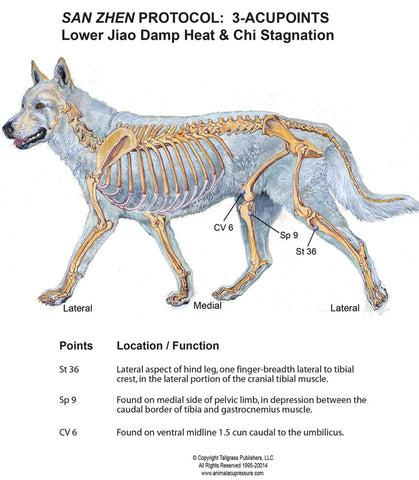
For Molly, the selected three-acupoint protocol was designed to support movement of chi, drain Damp, and clear Heat from the Lower Jiao.
CV 6, known as the “Sea of Chi,” was included to support and regulate Chi in the lower abdomen. When chi is stagnant, a dog may show signs of discomfort, tension, or altered elimination patterns. Supporting chi movement may help encourage a more balanced energetic flow.
SP 9 was selected for its traditional role in transforming and draining Damp. In TCM, Damp may be associated with fluid imbalance, heaviness, concentrated urine, and other signs suggesting that the body is not moving fluids efficiently.
ST 36 was added because it is widely used to support overall vitality, digestive function, chi movement, and the body’s ability to resolve Damp patterns. Together, CV 6, SP 9, and ST 36 form a focused San Zhen combination appropriate for Molly’s TCM pattern.
During an animal acupressure session, each point should be held with a calm, light touch and adjusted to the individual dog’s comfort and tolerance.
Molly’s Canine Acupressure Progress
Molly received three acupressure sessions over a two-week period and would likely need several additional sessions in the coming weeks to continue supporting her urinary health.
After her third session, Molly appeared more comfortable and less nippy. Her guardians reported that her urine had become lighter in color and that the previously strong odor was almost back to normal. Her Lower Jiao felt only slightly warmer to the touch, and she was only mildly reactive at BL 28.
Molly’s guardians continued to work closely with their holistic veterinarian throughout the process. This San Zhen three-acupoint combination appeared to provide valuable complementary support for Molly’s overall comfort and wellness.
Important Veterinary Note
Animal acupressure is a complementary wellness modality and is not a replacement for veterinary examination, diagnosis, or treatment. Dogs experiencing urinary discomfort, straining to urinate, pain, fever, blood in the urine, or behavioral changes should be evaluated promptly by a veterinarian.