Tallgrass Animal Accupressure Institute
Tallgrass Animal Accupressure InstituteHomeStoreTraing ProgramsTraining ScheduleRegistrationTallgrass Animal Accupressure Institute
Tallgrass Animal Accupressure Institute

In Search of Animal Acupressure & Massage Business Opportunities

By Anne Angelo,  LCSW, SAMP
After relocating from New York State to New Jersey I sought the advice of a friend, Kathy McCarry, for some new marketing strategies to help build my small animal massage & bodywork practice. Cathy is the co-founder of “Fitness 4 Paws”, an organization that provides post-surgical services to dogs. I sought her advice as she has successfully created a partnership with Stoney Creek Veterinary Hospital (SCVH) in Morton, PA. This partnership has resulted in an influx of canine massage & bodywork clients for Cathy.

SCVH has embedded “Fitness 4 Paws” into their ACL, TPLO and other surgical procedure packages. Included in this package are eight follow up sessions for all dogs who are cared for by SCVH. Cathy develops a personalized plan for each dog that incorporates massage, cold laser, treadmill and homework.

When You Don’t Already Have an “In”
Cathy was fortunate to have a prior relationship with SCVH and was able to leverage this to promote her business. She noted that it is much easier to get started if one already has a relationship with an established animal care provider. Not having this advantage, Cathy’s advice to me was to contact local veterinarians with a proposal that was mutually beneficial. Continue reading

Posted in Acupressure Marketing & Media | No Comments

How Acupressure Can Help Equine Osteoarthritis

No horse is immune to arthritis. Both young and old horses can experience osteoarthritis, though we see it in older horses more often.
Equine Acupressure
The horse’s weight-bearing joints, the hock, fetlock, pastern, and coffin joints are most susceptible to arthritic changes. It is less common for a horse to develop arthritis in the stifle joints and spinal column, but it does happen. And, osteoarthritis can affect other joints where there’s been an injury or repetitive, abnormal stress applied over a period of time.

Osteoarthritis is the most common equine degenerative joint disease. It can be the result of impact trauma, injury, over-use, infection, poor conformation, hereditary issues, mineral or dietary deficiencies, and aging. Horses involved in competitive activities are more apt to develop arthritis at an earlier age due to the increased stress on their joints.

Being aware of common causes combined with early detection of arthritis affords us the opportunity to slow the progression of the disease. Early signs of arthritis can be:

• Mild swelling and heat in the joint

• Reluctance or refusal to perform in his usual sport

• Stiffness following inactivity

• Decrease in joint flexibility (range of motion)

• Crunching (“crepitus”) sound when the joint is flexed Continue reading

Posted in acupuncture, Equine Acupressure, equine osteoarthritis & acupressure, Holistic Horse Health | No Comments

Equine Acu-Fit, Acupressure for Equine Conditioning Program

ACU-FIT: Fit ness & Acu pressure,   By Amy Snow & Nancy Zidonis
Every owner has to make the final decision about what is best for their horse. We all want our horses to be “ready, willing, and able” to perform whatever task we ask. Being realistic at each stage of conditioning and being conscious of the particular horse’s capabilities and limitations is essential to avoid sudden or repetitive injuries. Working with an experienced
pro is usually helpful; however, there’s another ingredient you can add to your conditioning process.
Traditional Chinese Medicine & Horses
Equine acupressure has been used for thousands of year to optimize performance. The ancient Chinese treasured their horses because they provided military might, transportation, and support of agricultural life. Their culture and survival were dependent on the health of their horses and livestock. Traditional Chinese Medicine (TCM) evolved out of clinical observation throughout the centuries of folk medicine for humans and animals. Acupressure is based on the theories and concepts underlying TCM. Acupressure is safe, deceptively gentle, and always available. You, even as a novice, can offer your horse an acupressure session that can support your conditioning program. The intention behind an acupressure session for your horse is to nourish the body tissues needed to build strength and flexibility as well as maintaining a positive attitude for training. The acupressure session provided in this article, though not specific to your horse, can contribute to his physical and emotional well-being when added to your training regime.
How Acupressure Works
According to Chinese medicine the two most vital substances, blood and chi (also seen as qi or ki and pronounced “Chee”), must flow harmoniously though the horse so that the internal organs can function properly to nourish the entire body. Chi is life-promoting energy that supports all the body’s functions such as respiration, keeping the body warm, moving food through the digestive system, and maintaining the immune system. Blood is all the nutrient-rich fluids in the body. Blood and chi are seen to flow along energetic pathways or channels often called “meridians.” When chi and blood become blocked due to an injury, stress, or any form of constraint it most likely leads to an internal imbalance.
By palpating known acupoints, you can encourage the flow of chi and blood and help resolve blockages that can occur. Horses are hard-wired to not show when and where they hurt. In the wild a horse is left behind when the herd moves on to another grazing area if he is not able to keep up. Not demonstrating weakness is a matter of survival. Your horse may experience a minor muscle strain or tightness and simply begin to compensate for it and you may not notice. One compensatory behavior can lead to another and the next thing you know, the horse has a more complicated issue or injury. Better to stay ahead of the situation by offering your horse a general acupressure session. This will help support the harmonious flow of chi and blood throughout his body.
Acupressure Session for Training
Acupressure supports training and conditioning programs by helping to maintain the flow of blood and chi to nourish the horse’s internal organs and tissues while also supporting the animal’s heart and emotional stability. Stomach 36 (St 36), Leg Three Miles – this acupoint is
known to enhance the flow of blood to the fore-limbs, thus helping to build healthy muscles. Additionally, St 36 is responsible for the health of the digestive tract which can be an issue during rigorous training.


Gall Bladder 34 (GB 34),Yang Mound Spring – Through clinical observation, GB 34 has proven to strengthen and enhance the flexibility of the tendons and ligaments. Liver 3 (Liv 3), Great Thoroughfare –Liv 3 influences the harmonious flow of chi and blood throughout the horse’s body and nourishes the other internal organs. Bai Hui, Heaven’s Gate is a classic equine acupoint that helps with emotional issues along with bringing blood and chi to the back and hindquarters which is so important for impulsion. Use these points in your horses acupressure sessions to keep him acu-fit!

Posted in Uncategorized | No Comments

Acupressure Helps Canine Osteoarthritis

Amy Snow & Nancy Zidonis, Tallgrass Animal Acupressure Institute

Older dogs are prone to developing arthritis. However, young dogs can develop arthritis due to trauma to the joint, hereditary malformations, breeding issues, unstable joints, poor diet, and infection. Early detection is key to slowing the degenerative process and managing the dog’s level of pain.
Indicators of canine arthritis include:
·         Reluctance to play, walk, run, climb, jump
·         Swelling and heat at the site
·         Favoring a limb (limping)
·         Difficulty getting up or standing
·         Moving stiffly
·         Protecting a limb
·         Avoiding being touched
·         Change in attitude / personality
·         Weight gain
·         Less alert
·         Sleeping more, and,
·         Crunching (“crepitus”) sound when the joint is flexed.

Your holistic veterinarian, acupressure practitioner, and canine nutritionist are good resources for your dog to be as comfortable as possible for as long as possible. Because there are many different types of canine arthritis, consulting professionals who can help zero-in on the exact joint problem is the best strategy for your dog’s comfort.

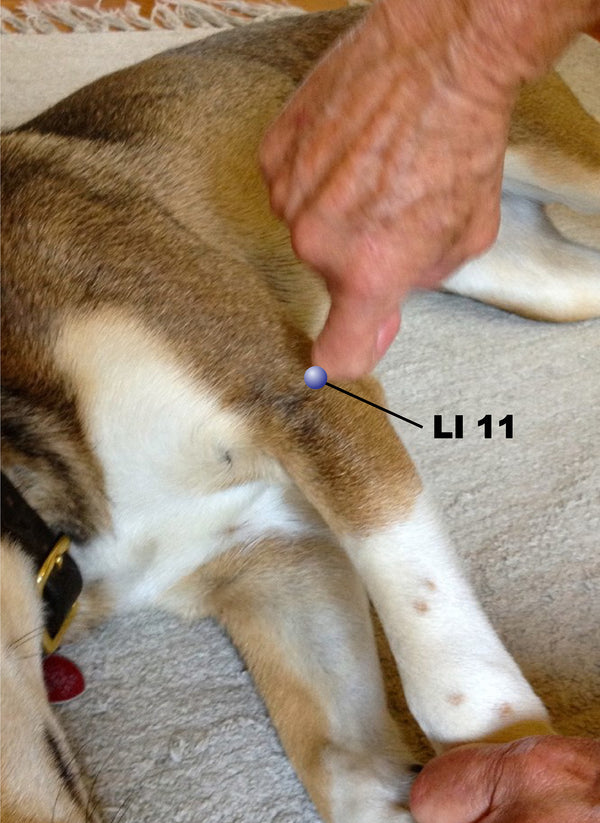
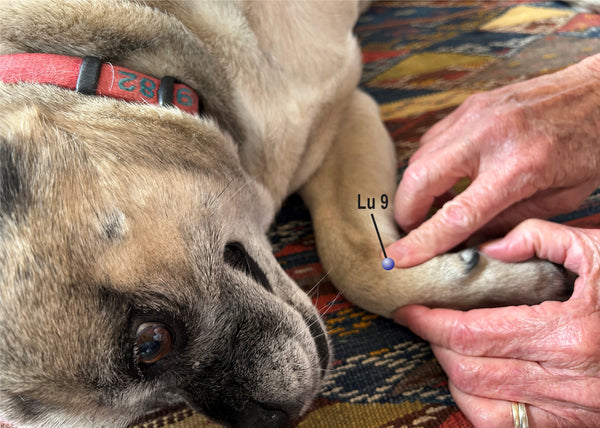
You can begin to offer your dog comfort care for his arthritis by using working the acupressure points given below in the chart.

Acupressure helps dog arthritis

Posted in acupuncture, Canine Acupressure, TCM & General, Uncategorized | Tagged , | No Comments

Which Vaccinations Should You Give Your Horse?

Which Vaccinations Should You Give Your Horse?
By: Dr Madalyn Ward
“Should I vaccinate my horse? If so, which vaccines should I give?”

I get asked these questions all the time in my practice, usually from
concerned horse owners who use a holistic management program. I can
usually help my clients make informed decisions about which, if any,
vaccinations to give because I know their horses well. Most of my
clients are well aware of that while vaccines can protect their horses
against certain diseases, the side effects can often be worse than the
disease itself.

But many people are not aware of this risk-reward formula that comes
with vaccination. In fact, when I look up the most common Google
searches for horse vaccines I find that most queries are about
vaccination cost, frequency, and availability. Almost no one is
asking, via searches, whether they should vaccinate their horses at
all, or whether vaccines have negative side effects.

Yet, the decision about whether to vaccinate your horse, and with
which vaccines, is a serious one that takes a bit of thought and
research.

Vaccination: Risk and Reward
Obviously the positive side of vaccinating horses is that your horse
has some protection against certain diseases, especially diseases that
are fatal. This is the “reward” side of the vaccination equation.

The risk side of the equation relates to the possible side effects
that may affect your horse later in life. Over-vaccinated horses, or
horses who are not healthy enough to withstand vaccination can suffer
from (to name a few):
laminitis
melanomas
chronic colic and digestive issues
chronic respiratory infections
flare-ups of chronic illnesses previously under control
metabolic dysfunctions
Continue reading

Posted in Feline Acupresure, Tui Na, Uncategorized | Tagged , | No Comments

The Tale of a Coprophagic Mare…Penny the Poop-Eater

By: Lynn Caldwell & Diane Wilson, Certified Equine Acupressure Practitioners

Penny is a 10-year-old Paint Mare with a long-standing habit of manure eating – her own manure and others’.  Bleh!  Healthy in every other respect, and having been assessed by her veterinarian with no conclusive medical issues, her owners called us, hoping acupressure might help to eliminate (excuse the pun) this behavior.

It’s unknown when Penny’s manure habit started.  She came to her current home just one year ago.  Prior to that, she had had at least six different owners.  When she came to what is now, hopefully, her forever home, Penny made a strong bond with a gelding who died within a couple of months after her arrival.

Lots of thoughts…was her behavior learned from another horse somewhere along the way?  …was she expressing an emotional behavior due to stress, grief, and loss? …had she been deprived of food at some point, and took to manure eating in order not to starve? …could she be self-medicating an ulcer?  These were a few of our many ‘Penny scenarios.’ Continue reading

Posted in Equine Acupressure, TCM & General | 2 Comments

Tui Na for Sore Backs – Equine Acupressure

Tui Na for Sore Backs
Amy Snow & Nancy Zidonis

At the Rocky Mountain Horse Expo, March 9 – 11, Amy and Nancy gave 2 demonstrations. The Tui Na demonstration is presented below. Contact Tallgrass  and request a pdf handout with charts of their presentations; Tui Na for Sore Backs and Springtime Acupressure Tune-Up.

Tui Na is the Massage Form of Traditional Chinese Medicine
Classics on Massage of the Yellow Emperor and Qi Bo during the Qin Dynasty (221-207 BC)
Tui Na is the Original Chinese Meridian Massage that has been used continuously for 1000s of years for humans and horses.It is used more than acupuncture in China today.

Traditional Chinese Medicine

  • Whole horse approach – 4 Examinations: Observe, Listen & Smell, Questions, Physical
  • Vitality = Chi/Energy & Blood circulating harmoniously and nourishing organs and tissues
  • The role of Meridians – pathways or channels throughout the body
  • Spirit of the horse is key – love bond, care, usefulness/purpose, exercise, nutrition Continue reading
Posted in Equine Acupressure, TCM & General, Tui Na, Uncategorized | Tagged , , | No Comments

The Canine Acupressure Touch

Gretchen Dietz, Licensed Small Animal Massage Practitioner and Swim Therapist

The first time I met Harley, he jumped straight up, five feet in the air as if all four legs were pogo sticks — 70 pounds of his Wheaton-mix frame skyward like a cartoon character. And just like a cartoon character, I swear there was the distinct sound of Boing Boing Boing with every excited launch.

Acupresure dog, HarleySix year old Harley lives with my sister-in-law, Deb, and her family in Phoenix, Arizona where I stayed while attending the Tallgrass Animal Acupressure Institute’s Introduction to Acupressure course. A rescue, Harley has lived with Deb’s family for about a year and while he is a perfect gentleman in many regards he is, to say the least, energetic.

I knew the instructors of the Intro class were looking for “demo-dogs” and at first I thought there was no way Harley would be a good candidate.

Then I touched him. As a licensed small animal massage practitioner, I thought I’d see how Harley responded to touch before I made the decision to bring him to class. I calmly laid my hands on Harley’s withers and what do you know — he let out a big sigh, sat down between my legs, and melted. Continue reading

Posted in Canine Acupressure, TCM & General | No Comments

Tallgrass Animal Acupressure Applauds Friends of Sound Horses

FOSH Commends U.S. Attorneys Office

Friends of Sound Horses (FOSH) applauds the U.S. Attorney’s Office for the Eastern District of Tennessee in Knoxville for the successful criminal prosecution of Barney Davis, a horse trainer from Tennessee for violation of the Horse Protection Act (HPA).  Mr. Davis was sentenced to 12 months and one day and to pay a $4000 fine for the cruel abuse of soring a gaited horse which is illegal under the HPA.Equine Acupressure supports no animal abuse  He is also ordered to either write an article or cooperate in the production of an educational video describing horse soring methods and their short and long term effects on the horses; how widespread the practice still is in the industry; and demonstrating how inspectors can better detect sored horses.  This is the first HPA criminal prosecution in twenty years. Continue reading

Posted in Uncategorized | Tagged | No Comments

Acupressure & Acupuncture: What’s the Difference?

By Nancy Zidonis and Amy Snow, Tallgrass Animal Acupressure Institute

     A horsefly is mid-air, within inches of landing on the horse’s flank.  The surface of his flank twitches just before the fly has a chance to land, warding it off in advance of being stung.  This is how sensitive a horse is!  He can feel everything within inches of his body.  Whether this is a voluntary or involuntary response to the fly’s approach, it doesn’t matter, since it is purely information about how conscious and connected the horse is to the surface of his body and his immediate environment.
It is because of the extraordinary awareness of his body and surrounding “personal space,” the horse is highly responsive to the powerful, yet seemingly gentle, ancient estone acupuncture needlesastern healing modalities.   Acupuncture and Acupressure are based on the same principles of Traditional Chinese Medicine (TCM).   The Chinese have found stone needles (Bian Shi) in tombs that are considered to be 5000 years old.  Historians have noted that acupressure began at about the same time or before acupuncture. Continue reading

Posted in Canine Acupressure, Equine Acupressure, TCM & General | No Comments